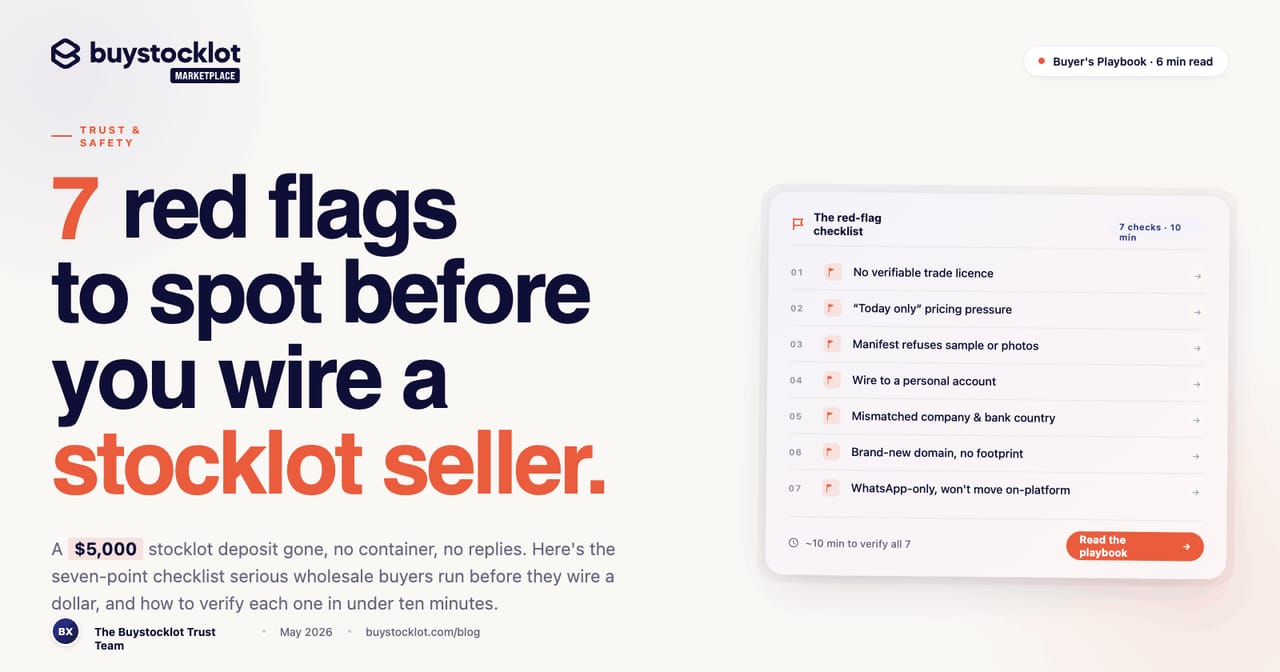
Every week, someone messages us asking how to recover a deposit they sent to a Telegram contact who promised 5,000 units of branded sneakers at a price too good to be true. The container never arrived. The number stopped responding. The "company" never existed.
This post is the checklist we wish every first-time wholesale buyer ran before they wire money. Each item takes minutes to verify and any single failure should pause the deal until it's resolved.
1. They refuse to do a video call
A legitimate liquidator will walk you through the warehouse on a 5-minute video call. They will pan the camera across pallets, show you the goods, hold up a labelled box. If your seller invents reasons to avoid this — "the warehouse is closed today," "WhatsApp video is broken in our country" — you're talking to a broker who doesn't actually have the stock, or worse, to nobody at all.
What to do: Insist on a live call. Not a recorded video. Live, with your face on screen too, asking them to move the camera to a specific corner.
2. The price is more than 30% below comparable wholesale
True overstock and closeout deals are 20–40% below retail wholesale — sometimes higher on end-of-season or end-of-line lots. But if someone offers Nike Air Max at $12/pair when the genuine wholesale floor is $35, you're looking at counterfeit goods, stolen freight, or a scam.
What to do: Cross-reference the price against at least three other sources. Sites like Buystocklot, B2BZone, and live broker chat groups all post real comparable lots.
3. They want the full payment upfront via wire
The B2B industry standard is 30% deposit on confirmation, 70% against shipping documents (bill of lading copy, packing list, container number). If a seller insists on 100% upfront via bank wire — especially to a personal account or a third-country shell — you have zero leverage if the container never moves.
What to do: Counter-propose 30/70. A real seller will accept it. A scammer will pressure you with "we have other buyers, decide today."
4. The company has no verifiable footprint
Search the company name plus the year of incorporation. A real liquidator who has been moving FMCG, electronics, or apparel for five years will have a trade license, a Google Maps pin, a LinkedIn page with employees, and reviews on Trustpilot or independent forums. A fresh Gmail address with no other digital trace is the single most common scam signature.
What to do: Run the company name through the trade registry of the country they claim to operate in. UAE, Turkey, Netherlands, Italy, and Germany all have free public lookups.
5. The product photos are recycled
Reverse-image-search every photo they send you. If the same pallet appears on a Russian Telegram channel from 2023 and on an Egyptian Facebook group from 2024 and now in your inbox from a "Romanian supplier," nobody owns those goods.
What to do: Use Google Lens or TinEye. Ask for a fresh photo with today's date written on a piece of paper held next to the pallet. Real sellers don't blink at this.
6. They refuse to use escrow or a verified marketplace
Marketplaces like Buystocklot exist to put a trust layer between you and a seller you have never met. Even without escrow handling money, a verified-seller badge means somebody else has already checked their trade license, bank account, and warehouse address.
What to do: Move the conversation to a marketplace with KYB-verified sellers. If your contact refuses, that tells you everything.
7. The contract avoids inspection rights
Every clean wholesale contract has an inspection clause: buyer or buyer's agent has the right to inspect goods at origin before shipment. Pre-shipment inspections from firms like QIMA, Intertek, or SGS cost a few hundred dollars on a $50,000 container — cheap insurance.
What to do: Insist on inspection rights in the contract. If the seller refuses, walk away. They are hiding something — wrong quantity, wrong condition, or no goods at all.
The bottom line
None of these red flags are difficult to check. The hard part is having the discipline to actually run the checklist when a deal looks too good and a seller is rushing you. The buyers who never get burned are not the smartest — they are the slowest. They walk away from 9 out of 10 offers, and the 1 that survives the checklist is the one that ships.
Stay patient. Verify everything. And if you have already been scammed once, you are not stupid — every long-time B2B buyer has at least one war story. Just don't repeat it.